



- The initiative, funded by the European Union through the Interreg Spain-Portugal (POCTEP) 2021-2027 programme, promotes the use of exoskeletons and assistive technologies to reduce musculoskeletal injuries among care professionals and improve their working conditions.
Physical injuries associated with the mobilisation and care of people in situations of dependency are one of the challenges faced by care professionals. Musculoskeletal disorders resulting from patient mobilisation are one of the main causes of sick leave in the care sector.
Lower back and back injuries can, in many cases, bring professional careers to an end and further aggravate the already critical shortage of staff in the sector. It is in this context that EXOCARE was created: a cross-border project bringing together organisations from Galicia and Portugal with the aim of addressing this challenge through cooperation, training and technological innovation.
Led by the Fundación Escuela Universitaria de Relaciones Laborales de A Coruña (ERLAC), the project aims to assess the situation across the Euroregion, develop specific training programmes and validate technological solutions adapted to care settings, with particular attention to exoskeletons and other assistive devices.
EXOCARE is based on the belief that technology can be part of the solution, and that caring for those who care for others is also a matter of social justice.
A joint strategy for assisted mobility
The project consortium brings together leading organisations in health, research and knowledge management from both sides of the border. Led by Fundación ERLAC, the consortium includes the Axencia Galega para a Xestión do Coñecemento en Saúde (ACIS), the Servizo Galego de Saúde (SERGAS), the Unidade Local de Saúde do Alto Ave, E.P.E. (Portugal), the Universidade da Coruña (UDC), the Universidade do Minho (UMinho), DTx CoLAB, the Cluster Saúde de Galicia (CSG), the Dirección Xeral de Persoas con Discapacidade (Xunta de Galicia), together with the Dirección Xeral de Maiores e Atención Sociosanitaria (Xunta de Galicia), and the Santa Casa da Misericordia de Riba de Ave.
The project therefore establishes a joint strategy between Galicia and Portugal to analyse the situation of care professionals, develop specific training and advance the adaptation of technological solutions to the real needs of healthcare and care settings.
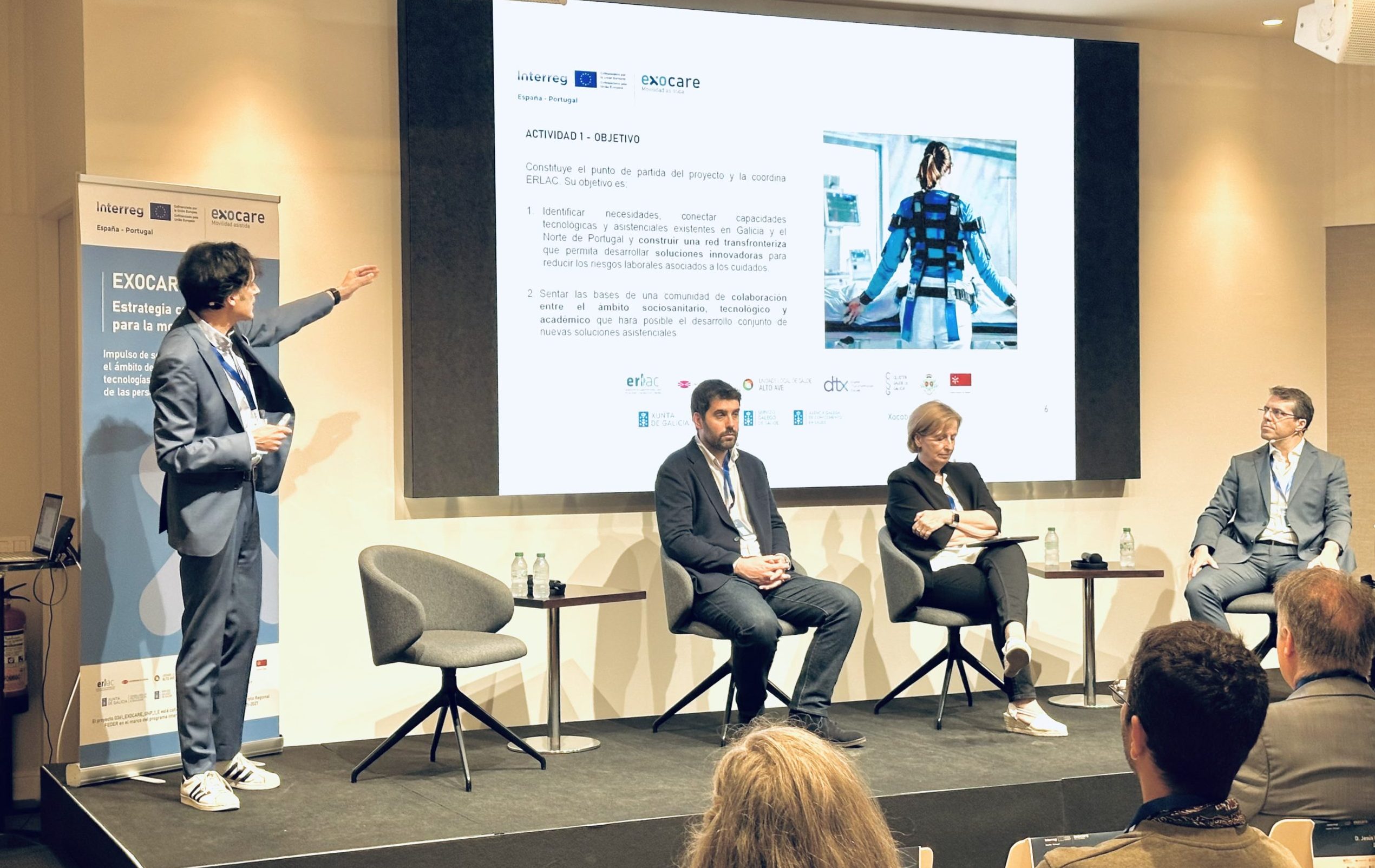
The project was officially launched in June
The official launch of EXOCARE took place last June at the Club Cámara Noroeste de A Coruña, in an event that brought all the partners together for the first time to present the project’s objectives, methodology and initial lines of joint work.
During the event, Jesús Vázquez Forno, Dean and Director of ERLAC, highlighted the participation of the different organisations as a reflection of the cooperation between Galicia and Portugal, bringing both regions together in a pioneering project for the sector and designed by and for healthcare professionals.
For his part, Miguel Araujo, from the Financial Management and Funded Projects Services of the Unidade Local de Saúde do Alto Ave, stressed that EXOCARE was created in response to a reality faced by hospitals: the impact of an ageing population on hospital and care staff. In this regard, he highlighted the potential of technology in supporting those who provide care.
About the EXOCARE project
EXOCARE is a cross-border cooperation project funded by the European Regional Development Fund (ERDF) under the Interreg VI A Spain-Portugal (POCTEP) 2021-2027 programme.
Its objective is to generate knowledge, training and technological solutions to improve the working conditions of care professionals in the Galicia-Northern Portugal Euroregion, with particular emphasis on reducing musculoskeletal injuries through the use of assistive devices such as exoskeletons.
More information: https://erlac-exocare.es/