


The Monitoring Committee of the Interreg VI-A Spain–Portugal Cooperation Programme (POCTEP) 2021–2027 has approved the terms and conditions for the 9th Call for Proposals, for the submission of applications to the Small Projects Fund (SPF), and the 10th Call for Proposals, whose application periods will open in September (on 9 and 29 September respectively).
The calls aim to promote participation in cross-border cooperation actions within the framework of POCTEP by establishing the conditions and rules governing the award of ERDF funding through a competitive selection process.
NOTE: The following information provides a summary of some of the key aspects of the calls. It is essential to read the full call documents, which are available for download at:
- 9th Call for Proposals – Terms and Conditions: Download in Spanish | Download in Portuguese
- 10th Call for Proposals – Terms and Conditions: Download in Spanish | Download in Portuguese
In the event of any discrepancy or difference in interpretation, the content of the official call documents shall always prevail.
9th Call for Proposals
This Call for Proposals for the Small Projects Fund (SPF) aims to promote participation in cross-border cooperation actions within the framework of POCTEP by establishing the conditions and rules governing the award of ERDF funding through a competitive selection process.
.
What funding is available under this call?
The ERDF allocation for this Call amounts to €10,000,000. The maximum ERDF co-financing rate is set at 75% of the eligible cost of each SPF operation.
The minimum budget for each application (Small Projects Fund) is €200,000. In addition, each public contribution to an individual small project (received by the final beneficiaries) must not exceed €100,000. Where aid is granted to an undertaking, it must not exceed €22,000.
.
Which applications may be submitted?
Each application shall consist of a single Small Projects Fund.
Proposals must fall within one specific objective only from those included in the Call and demonstrate their contribution to the expected results and indicators. The terms and conditions include an indicative list of the types of actions that may be funded.
The specific objectives include:
- SO 1.4. Developing capacities for smart specialisation, industrial transition and entrepreneurship.
- SO 2.1. Promoting energy efficiency and reducing greenhouse gas emissions.
- SO 2.7. Enhancing the protection and conservation of nature, biodiversity and green infrastructure, including in urban areas, and reducing all forms of pollution.
- SO 4.6. Strengthening the role of culture and sustainable tourism in economic development, social inclusion and social innovation.
- Interreg Specific Objective – Action (a). Improving the institutional capacity of public authorities, particularly those responsible for managing a specific territory, and of stakeholders.
- Interreg Specific Objective – Action (c). Building mutual trust, in particular by promoting people-to-people actions.
.
Who can submit an application?
Each Small Projects Fund (SPF) shall have a single Lead Beneficiary or Sole Beneficiary (LB/SB). Beneficiaries must have legal personality and be established as public bodies or entities of an equivalent public nature.
Entities eligible to apply as Lead Beneficiary or Sole Beneficiary include public bodies or equivalent entities, entities established under the Treaty of Valencia, international organisations whose objectives are compatible with those of the Programme, and legally established European Groupings of Territorial Cooperation (EGTCs) comprising institutions from Spain and Portugal.
IMPORTANT NOTE: The Sole Beneficiary (LB/SB) shall bear full financial and legal responsibility for the proper management of the operation before the Managing Authority (MA) and the other Programme management and control bodies. It must possess the administrative, technical, financial and economic capacity required to develop and manage the SPF, including launching the relevant calls, selecting projects, monitoring implementation and making payments to the final recipients of the small projects.
Accordingly, the MA may require the SPF Lead/Sole Beneficiary to demonstrate such capacity. It is therefore essential that the LB/SB carefully assesses its administrative, financial and management capacity before deciding to participate in the operation.
.
How and when should applications be submitted?
 .
.Applications must be submitted exclusively by electronic means through the Programme’s information system, Interreg (CoFFEE environment).
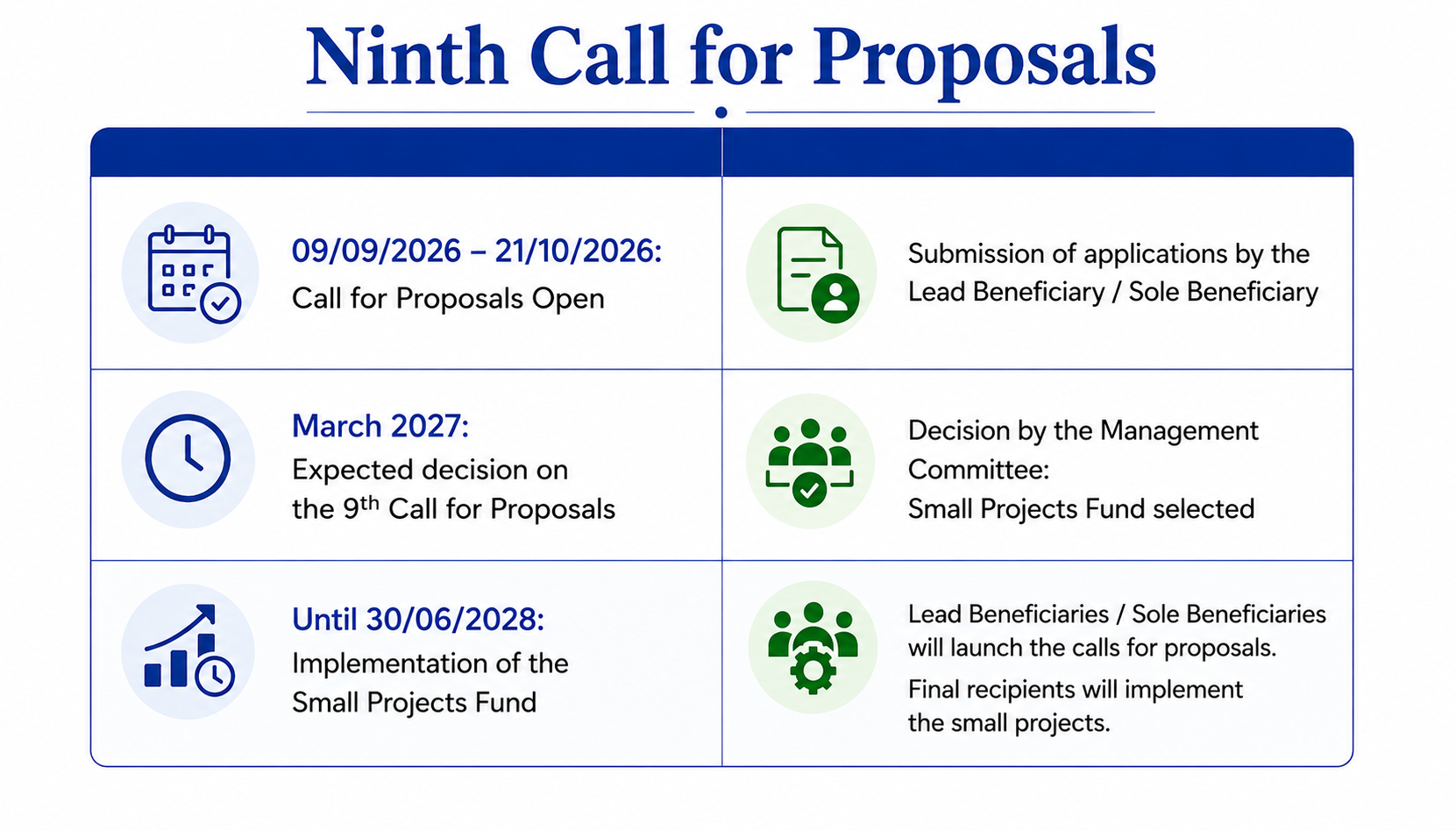
The application period will be open from 10:00 (Spanish mainland time) on 9 September 2026 until 14:00 (Spanish mainland time) on 21 October 2026.
.
What is the implementation period?
Expenditure shall be eligible from 1 January 2026. However, Small Projects Funds (SPFs) must not be physically completed or fully implemented before the date on which the application is submitted.
The maximum implementation period for Small Projects Funds ends on 30 June 2029.
.

9th Call for Proposals – Documents
9th Call for Proposals – Terms and Conditions: Download in Spanish | Download in Portuguese
Assessment criteria: Download in Spanish | Download in Portuguese
9th Call for Proposals – Application Form (working document). Applications must be submitted exclusively through CoFFEE. The guidance for completing the application form will be available shortly.
10th Call for Proposals
What funding is available under this call?
The ERDF allocation for this call amounts to an initial indicative budget of €21 million, based on the ERDF funding currently available. This amount may be increased using any remaining or released ERDF funds under each priority at the time the Call for Proposals is awarded. The maximum ERDF co-financing rate is 75% of the eligible project costs.
–
Which projects may be submitted?
Proposals must fall within one specific objective only under Priorities 1, 2, 3, 4, 5 or 7 of the Programme and demonstrate their contribution to the expected results and indicators.
The priorities and specific objectives covered by this call are:
Priority 1
- SO 1.1. Developing and enhancing research and innovation capacities and the uptake of advanced technologies.
- SO 1.2. Reaping the benefits of digitalisation for citizens, businesses, research organisations and public authorities.
- SO 1.3. Strengthening the sustainable growth and competitiveness of SMEs and supporting job creation in SMEs, including through productive investments.
Priority 2
- SO 1.4. Developing capacities for smart specialisation, industrial transition and entrepreneurship.
Priority 3
- SO 2.1. Promoting energy efficiency and reducing greenhouse gas emissions.
- SO 2.2. Promoting renewable energy in accordance with Directive (EU) 2018/2001, particularly the sustainability criteria set out therein.
- SO 2.4. Promoting climate change adaptation, disaster risk prevention and resilience, taking ecosystem-based approaches into account.
Priority 4
- SO 2.7. Enhancing the protection and conservation of nature, biodiversity and green infrastructure, including in urban areas, and reducing all forms of pollution.
Priority 5
- SO 4.1. Improving the effectiveness and inclusiveness of labour markets and access to quality employment through the development of social infrastructure and the promotion of the social economy.
- SO 4.2. Improving equal access to inclusive and quality services in education, training and lifelong learning through the development of accessible infrastructure, including by fostering the resilience of online and distance education and training.
- SO 4.5. Ensuring equal access to healthcare by strengthening the resilience of healthcare systems, including primary care, and promoting the transition from institutional to family- and community-based care.
- SO 4.6. Strengthening the role of culture and sustainable tourism in economic development, social inclusion and social innovation.
Priority 7
- Interreg Specific Objective – Action (a). Improving the institutional capacity of public authorities, particularly those responsible for managing a specific territory, and of stakeholders.
- Interreg Specific Objective – Action (b). Improving efficient public administration by promoting legal and administrative cooperation and cooperation between citizens, civil society representatives and institutions, particularly with a view to resolving legal and other cross-border obstacles.
- Interreg Specific Objective – Action (c). Building mutual trust, particularly by promoting people-to-people actions.
- Interreg Specific Objective – Action (f). Other actions supporting better cooperation governance.
All projects funded under the Programme must demonstrate a strong cross-border dimension and impact, both in their design and implementation, with a clear focus on achieving results.
.
Who can submit an application?
All projects must be led by a Lead Beneficiary (LB), who shall bear full financial and legal responsibility for the project as a whole.
Eligible beneficiaries and partners include: public authorities, local authorities, regional development agencies, universities and other higher education institutions, vocational education and training centres, technology centres, science, technology and business parks, associations, foundations and public or private research institutes, public employment services, businesses (including SMEs and micro-enterprises) and social economy organisations, chambers of commerce, clusters and business associations, civil protection services, workers’ organisations, interest groups including NGOs and civil society organisations, European Groupings of Territorial Cooperation (EGTCs), organisations managing protected natural areas, bodies promoting cross-border cooperation, and other relevant stakeholders..
.
How and when should applications be submitted?
Applications must be submitted exclusively online through the Programme’s information system, CoFFEE Interreg. Applications must be completed in one of the Programme’s two official languages: Spanish or Portuguese.
The application period will run from 10:00 on Tuesday, 29 September 2026 until 14:00 on Tuesday, 17 November 2026 (Spanish mainland time).
.
What is the implementation period?
Expenditure shall be eligible from 1 January 2026. However, projects must not be physically completed or fully implemented before the date on which the application is submitted.
The maximum implementation period for projects under this Call for Proposals will end on 30 June 2029.
The financial plan must be realistic, and each beneficiary must achieve a minimum implementation rate of 80% of its approved annual budget.
10th Call for Proposals – Documents
10th Call for Proposals – Terms and Conditions: Download in Spanish | Download in Portuguese
10th Call for Proposals – Application Form and Guidance for Completing the Application Form: working documents. Applications must be submitted exclusively through CoFFEE.